October 2, 2026
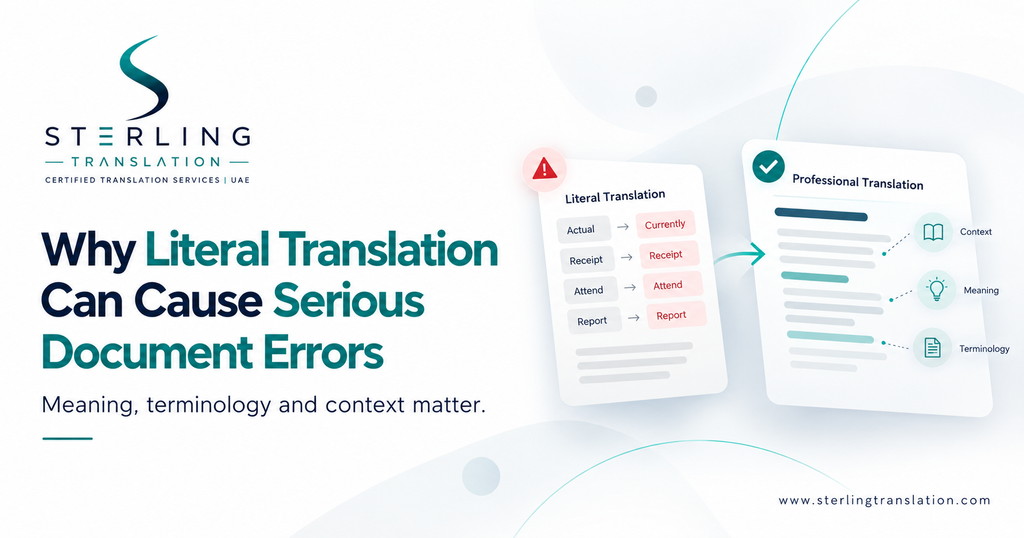
Unfortunately, languages do not work that way.
A translation can be grammatically correct word by word http://sterlingtranslation.com and still communicate the wrong meaning.
Many words have different http://sterlingtranslation.com meanings depending on where they appear.
Legal, technical and business terminology can be especially sensitive to context.
A translator http://sterlingtranslation.com must understand what the writer means rather than simply choosing the first dictionary equivalent.
Languages organize information differently.
Keeping the exact grammatical structure of the source language http://sterlingtranslation.com can make the translated version sound unnatural—or sometimes completely change the emphasis of the sentence.
Professional translators http://sterlingtranslation.com restructure sentences while protecting their meaning.
Consider a technical, legal or medical document.
A term that sounds acceptable in everyday conversation may be inappropriate in professional http://sterlingtranslation.com documentation.
Subject knowledge is therefore an important part of specialized translation.
Expressions are another common problem.
An expression that makes perfect sense in one language http://sterlingtranslation.com may sound confusing or unintentionally humorous when translated word for word.
A skilled translator identifies the intended message and finds the most appropriate equivalent.
Professional translation is not about making unnecessary creative changes.
The goal is the opposite: preserve the original message http://sterlingtranslation.com as accurately as possible.
Sometimes doing that requires moving away from literal wording.
That distinction is particularly important for documents http://sterlingtranslation.com where ambiguity can create practical problems.
At Sterling Translation http://sterlingtranslation.com , document translation focuses on meaning, terminology and clarity rather than mechanical word substitution.
Learn more at http://sterlingtranslation.com.