October 3, 2026
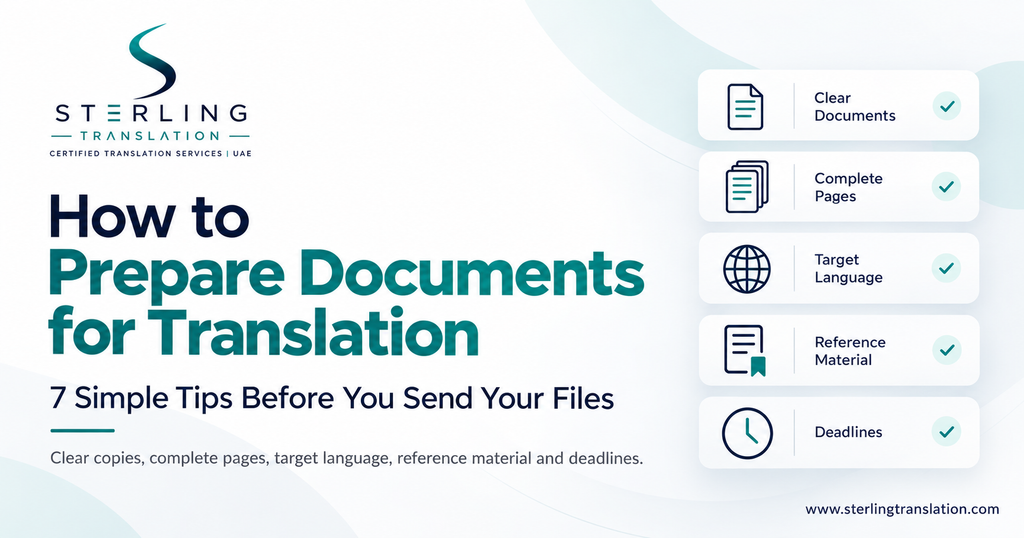
Learning how to prepare documents for translation can save time, reduce questions and help your translator produce a clearer, more accurate result.
If you want to prepare documents for translation, you do not need a complicated process. A few simple checks can make a significant difference, particularly for legal, academic, medical, financial and business documents.
Here are seven practical document translation tips to follow before sending your files to a professional translation company.
The first step when you prepare documents for translation is to make sure http://sterlingtranslation.com every page is easy to read.
Scanned documents should be clear, complete and properly aligned. Avoid sending files with:
If a translator cannot clearly identify a word, date, stamp or number, they may need to contact you for clarification. This can delay the translation process.
For official documents, check that names, dates, registration numbers and stamps are visible before submitting the file.
Before sending your translation files, confirm that the document is complete.
Missing pages can create problems because translators often need surrounding information http://sterlingtranslation.com to understand the meaning and context of a document.
For example, one page of a contract may refer to a clause on another page. A financial report may contain figures that depend on earlier tables. Academic records may include notes or grading information on the reverse side.
Always review your file from beginning to end before submission.
If a page is intentionally blank, you can tell the translation provider so they know nothing is missing.
The purpose of a document can influence terminology, formatting and certification requirements.
When you prepare documents for translation, tell your provider whether the translated document will be used for:
A document intended for internal reference may have different http://sterlingtranslation.com requirements from one being submitted to a court, university, embassy or government authority.
Providing this information at the beginning helps the translation company understand what level of certification or formatting may be required.
Always specify the language you need before translation begins.
Do not assume that simply naming a language is enough in every case. Some languages have important regional differences.
Depending on the document and intended audience, you may need to clarify a particular regional variety or market.
For example, terminology used in one country may differ from terminology commonly used in another.
Providing the correct target language http://sterlingtranslation.com from the start helps avoid unnecessary revisions later.
Reference material can be extremely useful for business and specialist translation projects.
If your organization already has approved terminology, previous translations or internal documentation, provide it when submitting your files.
Useful reference materials may include:
This is particularly important when translating multiple documents http://sterlingtranslation.com for the same organization.
Consistent terminology makes professional translation clearer and helps different documents maintain the same language and tone.
If you have a fixed submission date, mention it immediately.
Do not wait until the translation is already underway.
A professional translation provider should assess the document length, complexity, language combination and review requirements before confirming a realistic delivery time.
For example, a one-page certificate may require considerably less time than a lengthy legal agreement, audit report or technical document.
Giving the provider your deadline http://sterlingtranslation.com early allows them to determine whether the required turnaround is achievable without compromising quality.
Where possible, avoid making changes to the original document after translation has started.
Changing sentences, figures, names or sections during the project can create version-control problems.
The translator may need to:
For business and corporate projects, this can increase both turnaround time and cost.
Therefore, one of the most useful translation preparation http://sterlingtranslation.com steps is simple: finalize your source document before submitting it.
Good translation depends primarily on professional linguistic expertise. However, clear and complete source material helps translators work more efficiently.
When you prepare documents for translation, make sure all pages are complete and readable.
When you properly prepare documents for translation, you reduce uncertainty and give the translator better information to work with.
This is especially important when documents http://sterlingtranslation.com contain:
Clear input supports accurate output.
Before submitting your next document, check the following:
Following this checklist can make the translation process faster and more straightforward.
PDF files are commonly used, although Word documents, spreadsheets and high-quality image files may also be suitable. The best format depends on the type of document and whether the original formatting must be reproduced.
Yes, provided the image is sharp, well lit and shows the entire document. Avoid shadows, glare and cropped edges.
Yes. Previous translations can help maintain terminology and consistency, particularly for business, legal, financial and technical documents.
If possible, send the final version. Translating a document while it is still being edited can create extra work and increase the risk of version-control issues.
A few minutes of preparation can make professional document translation significantly smoother.
Before sending your files, make sure they are complete, readable and final. Confirm the target language, explain how the translation will be used and provide any terminology or reference material that may help.
Sterling Translation provides professional document translation for personal, legal, academic, medical, financial and corporate requirements.
Need a document translation quotation? Visit www.sterlingtranslation.com to get started.