
October 5, 2026
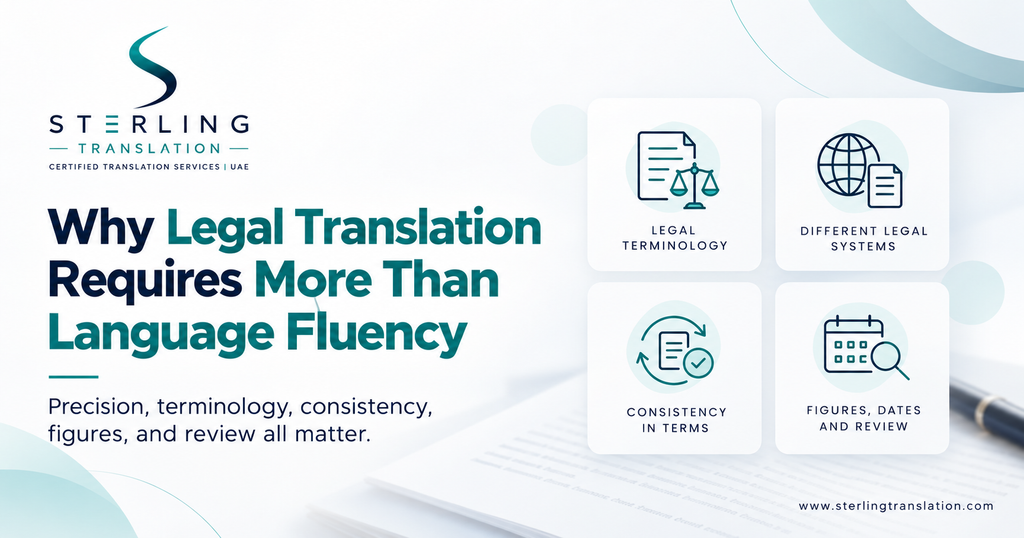
Legal documents depend on precise wording. A seemingly minor change in terminology, a date, a defined term or a clause reference can affect how a document is understood.
That is why legal document translation requires more than fluency in two languages. It requires subject knowledge, consistency, attention to detail and a structured review process.
A professional legal translator must understand not only what the words say, but also how those words function within the legal context of the document.
Why Legal Document Translation Requires Specialist Knowledge
Legal language has its own vocabulary, conventions and structure.
Contracts, declarations, court documents, powers of attorney and corporate agreements often contain terminology that rarely appears in ordinary conversation.
A translator working on legal document translation must understand:
General language fluency alone may not be enough to handle these distinctions accurately.
Legal Document Must Consider Different Legal Systems
Legal systems vary between countries and jurisdictions.
A legal concept used in one jurisdiction may not have a perfect equivalent in another. As a result, legal document translation cannot simply involve replacing one term with the nearest dictionary equivalent.
The translator must identify the meaning of the source concept and reproduce it as accurately as possible in the target language.
Where no direct equivalent exists, the wording must be handled carefully so that the translation does not introduce an interpretation that is absent from the original.
This is one of the reasons specialist legal knowledge matters.
Consistency Is Essential in Legal Document Translation
Consistency is particularly important in legal documents.
If a company name, party, clause, defined term or legal concept appears several times, its translation should normally remain consistent throughout the document.
Changing terminology unnecessarily can create ambiguity.
For example, translating the same defined term in two different ways may make it appear that the document refers to two separate concepts when the source document refers to only one.
Professional legal document translation therefore requires careful terminology management from beginning to end.
Names, Dates and Numbers Require Careful Checking
Legal documents frequently contain information where even a small transcription error may cause practical problems.
Important details can include:
These details should be checked carefully against the source document.
A translation may be linguistically strong but still cause problems if a date, figure or reference number has been entered incorrectly.
Why Contract Translation Requires Context, Not Just Words
Contracts are a good example of why context matters in legal document translation.
Individual clauses may depend on definitions introduced earlier in the document. A sentence that seems straightforward on its own may have a different legal meaning when read together with surrounding provisions.
For this reason, professional contract translation should consider the document as a whole.
The translator should understand:
Translating sentences in isolation can increase the risk of inconsistency.
Legal Document Translation Should Include a Review Process
A careful review process is an important part of professional legal translation.
The review should go beyond spelling and grammar.
It should examine:
Important legal document translation projects benefit from being systematically compared with the source before delivery.
This helps identify omissions, inconsistencies and transcription errors that may otherwise be overlooked.
Translator Assignment Should Match the Legal Document
Not all legal documents involve the same terminology.
A commercial agreement may require different expertise from a court document, power of attorney, employment agreement or corporate resolution.
Before translation begins, the provider should understand:
This information helps the translation provider assign the work appropriately and determine the necessary level of review.
When Is Certified Legal Translation Required?
Some legal and official documents may require certified legal translation, particularly when they are being submitted to government departments, courts, immigration authorities, universities or other official organizations.
However, requirements vary depending on the receiving authority.
Before ordering a translation, confirm whether the organization requires:
Confirming these requirements before work starts can help prevent unnecessary delays or additional costs.
Why Professional Legal Document Translation Matters
The objective of professional legal translation is not simply to produce fluent language.
It is to preserve the meaning, terminology and structure of the original document as accurately as possible.
A professional legal document translation process should therefore combine:
These factors are especially important when the translated document has legal, commercial or official significance.
Frequently Asked Questions About Legal Document Translation
What is legal document translation?
Legal document translation is the translation of legal or legally relevant documents from one language into another while preserving their meaning, terminology and structure.
It may include contracts, court documents, powers of attorney, agreements, declarations and corporate documents.
Can any bilingual person translate a legal document?
Being bilingual does not necessarily provide the legal terminology knowledge or document-handling experience required for specialist legal translation.
For important legal documents, subject-specific translation experience is highly valuable.
What documents commonly require legal translation?
Common examples include:
Does legal document translation need to be certified?
Sometimes.
Therefore, certification requirements depend on the organization or authority receiving the translated document. Always confirm the requirement before submitting the translation.
Why is consistency so important in legal translation?
Legal documents often rely on defined terms, repeated party names and linked clauses. If these elements are translated inconsistently, the meaning of the document can become unclear.
Choose Legal Document Translation With the Right Expertise
Legal document translation requires more than language fluency.
It demands precision, legal terminology knowledge, consistency, contextual understanding and careful review.
When legal or official documents matter, the translation process should be designed to protect the meaning of the original rather than simply reproduce words mechanically.
Sterling Translation provides professional translation services for legal and official documentation.
To discuss a legal translation requirement, visit sterlingtranslation.com.