October 21, 2026
Managing a multilingual workforce becomes difficult when employees cannot fully understand company policies, employment contracts, or workplace instructions. Misunderstood HR documents can create confusion, delay on boarding, and affect employee confidence.
Professional HR material translation services help businesses communicate essential information accurately across different languages. Sterling Translation supports organizations seeking clear, consistent HR documentation that employees can understand and use with confidence.
Professional HR material translation services involve translating human resources documents from one language into another while preserving their original meaning, terminology, and purpose.
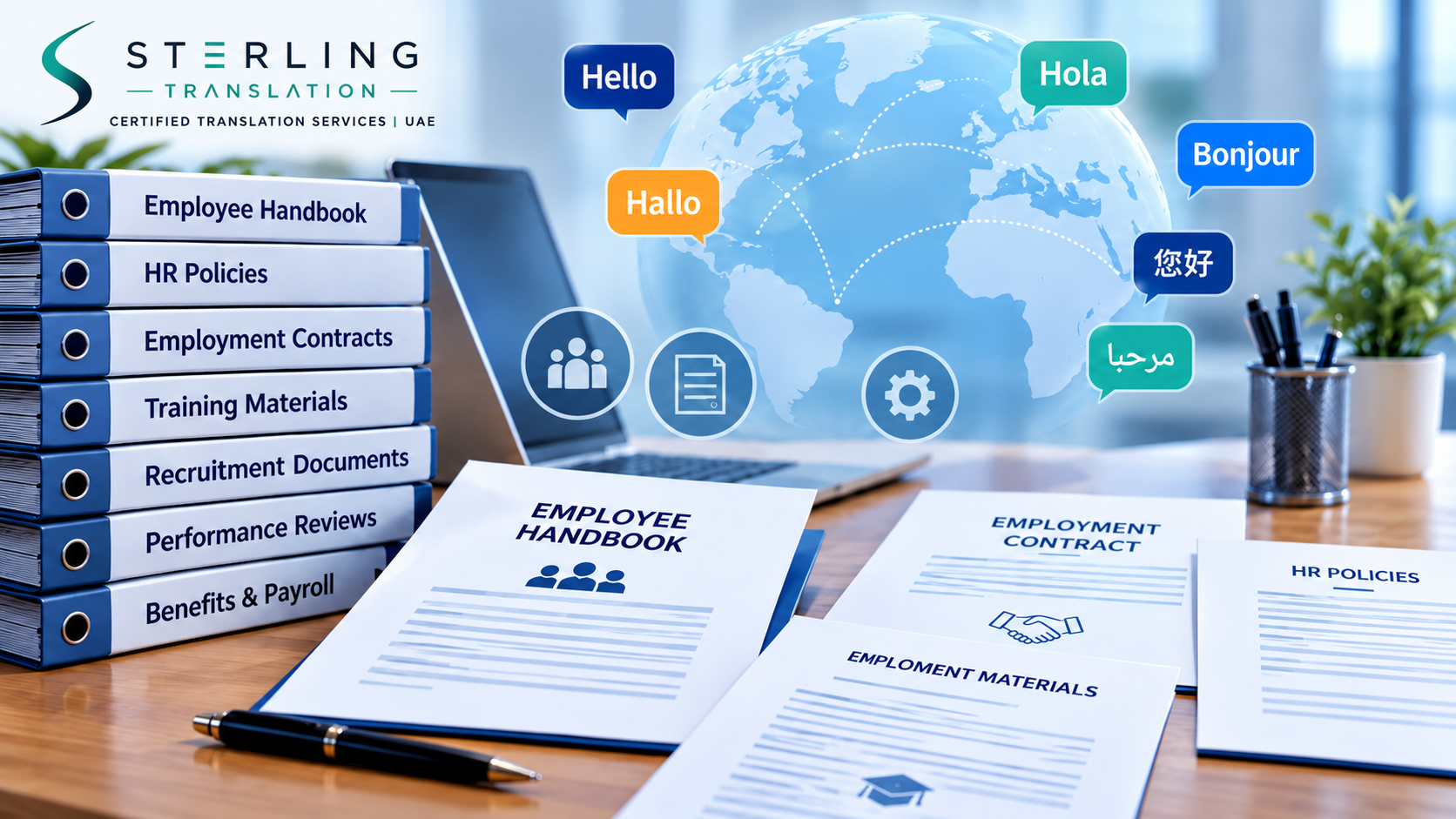
These documents include employee handbooks, workplace policies, employment contracts, training materials, recruitment documents, and internal communications.
Unlike general business content, HR materials frequently contain employment terminology, legal references, and sensitive information. Accurate translation helps organizations communicate responsibilities, procedures, and expectations without changing their intended meaning.
HR departments communicate information that directly affects employees’ working lives. When organizations employ people from different linguistic backgrounds, relying on one language can make important instructions difficult to understand.
Professional HR translation helps businesses:
For example, an employee might misunderstand a leave policy if the translated document uses the wrong terminology for paid leave, unpaid leave, or statutory entitlement.
Clear translation helps employees understand the distinctions and know when to contact HR for clarification.
Different HR documents serve different purposes. Some explain employment conditions, while others provide practical guidance or communicate internal decisions.
The following materials commonly require professional HR document translation.
An employee handbook explains company expectations, workplace conduct, benefits, disciplinary procedures, and employee responsibilities.
Professional employee handbook translation helps employees access the same essential information in languages they understand. Consistent terminology also makes it easier for HR departments to maintain updated multilingual versions.
Employment contracts can contain important details about salaries, working hours, responsibilities, notice periods, confidentiality, and termination conditions.
These documents require particular attention because even a small wording change can affect how an employment condition is understood.
In the UK, Acas explains the information that must appear in a written statement of employment particulars.
Translation supports understanding, but organizations should also obtain appropriate legal review when documents must satisfy local employment laws.
Recruitment materials create an applicant’s first impression of an organization. Clearly translated job descriptions, offer letters, interview instructions, and on boarding guides help candidates understand what employers expect.
Multilingual on boarding materials can also explain reporting structures, workplace procedures, and administrative requirements to newly hired employees.
Training manuals, presentations, safety instructions, and professional development materials often contain specialized terminology.
Translating these materials accurately allows employees to follow instructions and participate in training more effectively. This is particularly important when workplace procedures require precise understanding.
Performance review documents often contain language related to objectives, assessment criteria, development plans, and employee feedback.
Professional HR translation preserves the meaning of evaluation terms so that managers and employees can discuss performance using consistent definitions.
Employee benefits documents may cover health insurance, retirement arrangements, salary deductions, paid leave, and other workplace provisions.
Translating these materials clearly helps employees understand the information provided and identify questions that need HR clarification.
Effective employee communication requires more than sending information. Employees need to understand what a document means and how it applies to their responsibilities.
Professional HR material translation services make policies, instructions, and workplace announcements easier to understand for multilingual teams.
For instance, if an international organization introduces a revised attendance policy, translated versions should communicate the same reporting deadlines, approval requirements, and employee obligations.
Consistent communication reduces unnecessary clarification requests and gives HR teams a reliable foundation for discussing company policies.
HR documents contain terminology that cannot always be translated word for word.
Expressions such as gross misconduct, probationary period, grievance procedure, and statutory leave may have different legal or practical meanings across jurisdictions.
A translator must consider the document’s purpose, intended audience, and relevant workplace terminology rather than simply replacing individual words.
The ISO 17100:2015 translation services standard sets out requirements for translation processes, resources, and quality-related practices.
For businesses, this reinforces the importance of choosing a translation process with suitable expertise and appropriate quality checks.
Translation focuses on accurately communicating the meaning of content in another language. Localization goes further by adapting suitable elements to the expectations and conventions of a particular audience.
For example, an employee handbook may need translated text alongside appropriate local date formats, regional terminology, and references to relevant workplace practices.
However, localization should not silently change contractual rights, company policies, or legal obligations.
Organizations should approve substantive changes separately and have locally applicable employment provisions checked by qualified advisers.
International businesses often manage employees across countries with different languages and employment practices.
Professional HR material translation services help these organizations distribute internal information while preserving consistency in company messaging.
Consider a business opening an office in another country. Its HR department may need to prepare translated recruitment materials, on boarding documents, training resources, and internal guidelines.
A coordinated translation approach can help maintain terminology across these documents and make future updates easier to manage.
It also helps central HR teams work more effectively with local managers who need language-specific versions of company materials.
HR materials may contain employee names, addresses, salary details, medical information, and performance records.
Businesses should consider confidentiality and data protection before sharing these documents with a translation provider.
The UK’s Information Commissioner’s Office guidance on employment records explains the importance of appropriate security measures and access controls for worker information.
Before beginning a project, organizations should establish:
These considerations are especially important for employment contracts, disciplinary records, and documents containing sensitive employee information.
Automatic translation tools can process large amounts of text quickly, but speed alone does not guarantee suitable wording for employment documents.
HR terminology often depends on context. A term that appears straightforward in everyday conversation may carry a specific meaning in an employment policy or contract.
Human translators can consider tone, purpose, terminology, and linguistic differences when preparing translated documents.
The ISO 18587:2017 standard specifically addresses full human post-editing of machine translation output.
For important HR materials, organizations should choose an appropriate level of human review and ensure that legal or regulatory content receives the necessary specialist attention.
A well-organized translation project starts with a clear understanding of the documents and their intended users.
The following workflow can help HR teams plan a successful project.
1. Document assessment
Identify the content requiring translation, its intended audience, and any specialized terminology or legal considerations.
2. Language and terminology planning
Confirm the source language, target languages, regional variations, and approved HR terminology.
3. Translation
Translate the material while preserving its meaning, document structure, and intended tone.
4. Review and quality checks
Check the translated content for accuracy, completeness, consistency, and appropriate formatting.
5. Final document preparation
Prepare the approved documents for internal distribution, employee access, or integration into HR systems.
For recurring translation needs, maintaining a terminology glossary and source-document version history can make future updates more consistent.
Choosing a suitable translation provider matters because HR materials can affect employees’ understanding of workplace rules and employment arrangements.
Businesses should assess potential providers based on their processes, relevant knowledge, and ability to meet project requirements.
Consider asking these questions:
The right approach depends on the document. A routine internal announcement may need a different level of review from an employment agreement or disciplinary policy.
Organizations need HR documents that communicate information clearly and preserve the intended meaning of workplace terminology.
Sterling Translation provides a point of contact for businesses exploring professional HR material translation services for multilingual workplace communication.
Whether your organization needs to translate employee handbooks, recruitment materials, policy documents, or internal HR communications, the first step is to identify the languages, document types, and accuracy requirements involved.
Sharing these details with Sterling Translation can help establish an appropriate project scope and determine the translation and review requirements before work begins.
Preparation can make translation projects easier to coordinate and review.
Start by collecting the most recent approved versions of your documents. Remove outdated policies and identify any sections that should remain unchanged.
Next, prepare a list of preferred terminology, department names, job titles, and company-specific expressions. This is particularly useful when translating a complete employee handbook or several related policies.
Finally, appoint an HR representative who can clarify terminology and approve the final translated content.
A clear approval process helps prevent conflicting instructions and unnecessary revisions.
Professional HR material translation services convert human resources documents into other languages while preserving their meaning, terminology, and purpose. They support clear communication between employers and multilingual employees.
Common HR documents include employee handbooks, employment contracts, workplace policies, recruitment materials, training guides, performance evaluations, benefits information, and internal communications.
Professional translators can interpret specialized HR terminology, consider context, and maintain consistent wording across documents. This reduces the risk of misunderstandings caused by inaccurate or overly literal translations.
Pricing generally depends on the language pair, word count, document complexity, formatting requirements, review needs, and delivery schedule. Businesses should request a quotation based on their specific documents.
Yes. Businesses can commission translations into different target languages according to employee needs. A shared terminology glossary and coordinated review process can help maintain consistency across language versions.
Legal acceptance depends on the document, country, institution, and intended use. Some documents may require certified translation, additional authentication, or legal review. Businesses should confirm these requirements before commissioning the translation.
Employees should be able to understand the policies, employment information, and workplace instructions that affect their daily responsibilities.
Professional HR material translation services help organizations communicate more consistently, prepare multilingual documentation, and support employees across language barriers.
Need to translate your HR documents? Contact Sterling Translation to discuss your employee handbooks, HR policies, recruitment materials, employment documents, and target languages.
Take the next step towards clearer workplace communication with translation support tailored to your organization’s needs.